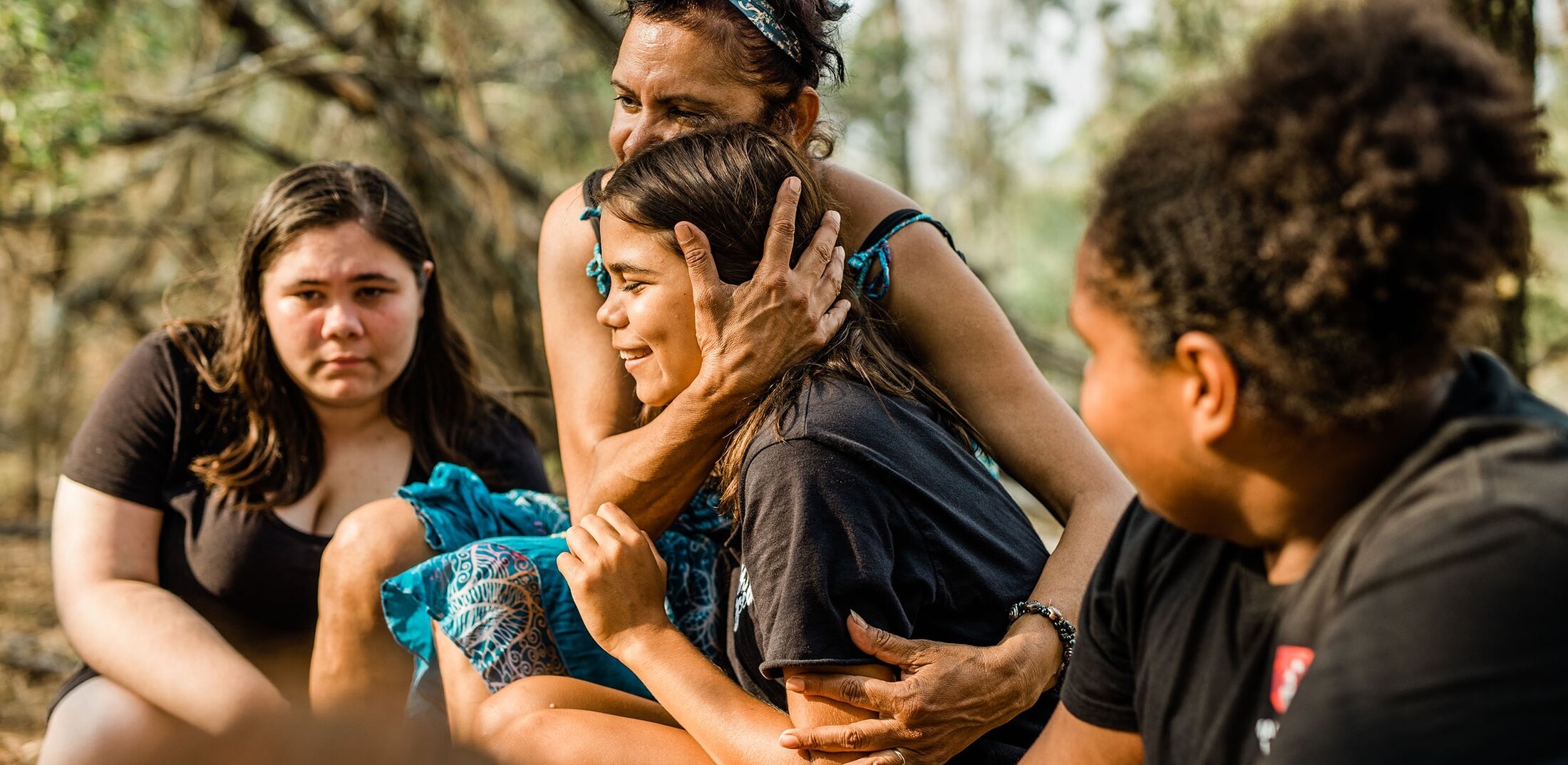
At the meeting place
‘This song is more than music - it just kinda came to us. Being out there on country, that moment in time. Healing, learning, connecting and building community. It’s sacred business, and we’ve been doing it for thousands of years.’
Many paths. One holistic impact.
We work in community arts and cultural development. Our areas of focus and impact are many. We foster an intersectionality of impact which sits at a crossroads – a meeting place of people, culture, intention, direction and change.
Each community-led creative programme can strengthen culture, wellbeing, belonging, skills, opportunity and public understanding at the same time. Click or tap a signpost to explore the areas of impact, or use the arrow keys and swipe left or right.
Content still to co-ordinate
Ocean to align this overview with the final Theory of Change and add a compact, source-checked set of overarching impact figures for funders.
Culture and identity
‘When it comes to knowledge, that’s a reflection on who you are. When you have cultural knowledge it makes you feel good inside.’
Culture is lived, shared and carried forward
Contemporary music, film and storytelling create space for cultural knowledge, language, history and identity to be explored on community terms.
- Strengthened cultural identity, pride and knowledge.
- Intergenerational dialogue between young people, Elders and knowledge holders.
- Professional creative works that form a growing living cultural archive.
Evidence and examples
External evaluations of Break It Down and CROSSROADS describe stronger cultural identity, knowledge, pride and connection to Country. The Cootamundra result is a small post-project feedback set: eight people answered this item and three did not.
Health, healing and wellbeing
‘Being part of the CROSSROADS Project has been incredible. Opportunities like this are rare in our community, and we see the positive effects on the kids, the community, and ourselves. Music is medicine.’
Creative expression opens a culturally safe way into hard conversations
DPM’s strengths-based process supports social and emotional wellbeing through connection – to self, emotion, family, community, culture, Country and Spirit.
- Greater confidence, hope, self-worth and emotional safety.
- Truth-telling and creative expression as ways to process difficult experience.
- Community-led health messages that people can recognise, own and share.
Evidence and examples
Break It Down and CROSSROADS participants and partners describe increased confidence, self-worth, aspiration and creative ways to express difficult experience. These are qualitative findings, not evidence that DPM provides treatment or causes clinical health outcomes.
Country, Spirit and belonging
‘I grew up in the bush, I feel a lot of connection with me and country. It’s a really spiritual thing. When I see country, I can read country.’
Stories made on Country strengthen belonging
Country is not a backdrop to the work. On-Country yarning, Elder-led knowledge, local language and place-based stories shape the creative process and its meaning.
- Deeper connection to Country, ancestors and Spirit.
- A stronger sense of grounding, identity and belonging.
- Local stories and knowledge carried into forms young people actively use.
Evidence and examples
Participants and Elders across Break It Down, CROSSROADS and DPM Futures describe cultural learning and connection to place. DPM’s new measurement framework proposes specific Country and Spirit measures; organisation-wide outcome data are not yet available.
Family and community connection
‘They make me feel at home … they feel like family.’
Making something together creates new connections
Projects bring young people, families, Elders, artists and local services into a shared process, culminating in a work the community can celebrate and keep.
- Stronger family, peer and intergenerational relationships.
- Community pride, participation, inclusion and collective ownership.
- New links to local services, mentors and support networks.
Evidence and examples
External evaluations describe peer, family, intergenerational and community connections around the creative process and community celebrations. Attendance is treated as reach, not proof of community-wide cohesion.
Learning and skills
‘It’s taught me to give things a try, because you never know where your secret talent lies. It opened an entire chapter of my life that I never want to close.’
People learn by making work that matters to them
Songwriting, performance, filmmaking and facilitation turn learning into an immediate, collaborative and visible achievement.
- Creative, technical, communication and teamwork skills.
- Confidence to participate, set goals and try unfamiliar roles.
- Re-engagement with learning through culturally relevant practice.
Evidence and examples
Evaluations describe learning in music, film, storytelling, cultural history, mental-health literacy and facilitation. DPM Futures documented 140 paid hours and about 20 check-ins for each of four participants; it was a small, intensive cohort rather than an organisation-wide rate.
Pathways and livelihoods
‘You want to be a role model – you’ve just got to take the first step. You take the first step, then someone else is going to see it.’
Creative confidence can become leadership and paid work
Mentoring and repeat engagement help participants move from first creative experiences towards facilitation, community leadership, further learning and employment.
- Young people recognised as artists, storytellers and role models.
- Professional confidence, portfolios and industry relationships.
- Local staff and artists engaged in delivery, keeping capability in community.
Evidence and examples
The CROSSROADS evaluation documented two Bourke participants employed by the local high school, one DPM trainee opportunity and one Moree participant starting a photography enterprise. DPM Futures adds four intensive pathway stories. These are concrete cases, not an employment rate.
Justice, safety and prevention
‘Being a part of this project made us realise how powerful we can be. Our voices are more powerful than our fists.’
Community voice can open safer choices
Young people and communities use creative work to examine violence, substance use, legal rights, racism and other difficult issues without being reduced to a deficit story.
- Safe truth-telling and critical reflection around lived experience.
- Locally authored messages about rights, responsibility and positive choices.
- Strengths, culture and aspiration placed at the centre of prevention.
Evidence and examples
Some participants and stakeholders connect DPM’s work with safer choices and reduced conflict. These are promising qualitative accounts, not measured crime-prevention effects; justice and safety remain a cross-cutting area for stronger future evidence.
Voice, representation and understanding
‘I have a voice now – and I won’t shut up with it!’
First Nations stories enter public life on their own terms
The finished works move beyond the workshop – reaching local audiences, online communities, broadcasters, classrooms, festivals and cultural institutions.
- Participants’ voices, identities and aspirations become more visible.
- Other communities can recognise shared experience and feel less alone.
- Wider audiences encounter strengths-based alternatives to racist stereotypes.
Evidence and examples
The 2025–28 Strategic Plan reports more than 200 projects, 90 communities and 6 million YouTube views. This is substantial reach, not evidence by itself of changed attitudes. CROSSROADS and Break It Down provide qualitative evidence of local voice and positive representation.
The ripple effect
‘Through these stories we learn from the past and understand our present, empowering us to create a new future … a better yarn for everyone.’
Change travels outwards – and forward through generations
DPM’s ripple model recognises change that can be seen close to a project, change that travels sideways through systems and audiences, and influence that may continue beyond what DPM can track.
- DirectProject participants explore identity, history, culture, wellbeing, hope and purpose through a supported community-led process.
- SecondaryFamilies, communities and wider audiences see local people heard and celebrated, and encounter new opportunities for reflection and learning.
- LateralPartners, services, governments and educators can use community insight to challenge perceptions and improve practice.
- UnknownStories have a life of their own. Their future audiences, uses and ripples cannot all be known in advance.
Together, these creative works form a living cultural archive whose influence can travel through communities and generations.
Evidence and examples
Near-term ripples include family pride, peer inspiration, mentoring roles and community use of media. Longer intergenerational and system change is DPM’s long-term theory rather than a measured organisation-wide result. All three external reports stress that return visits, local capacity, mentoring and sustained funding help keep the ember burning.
Swipe to turn